History
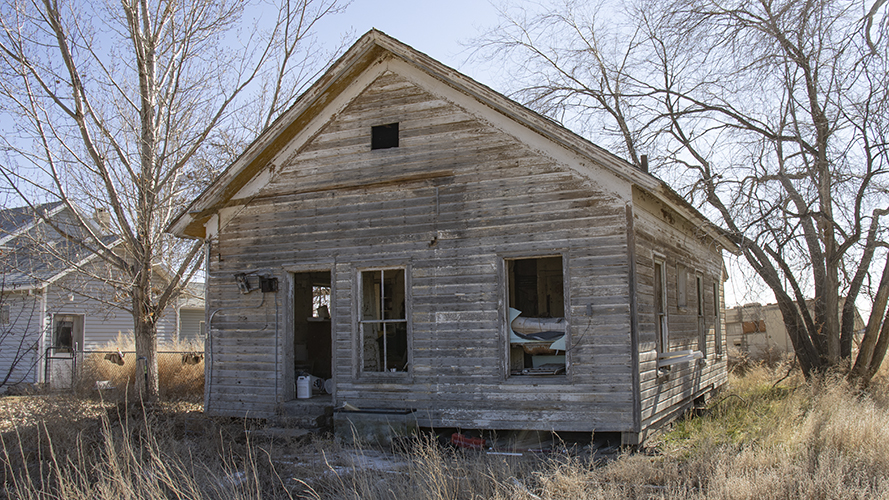
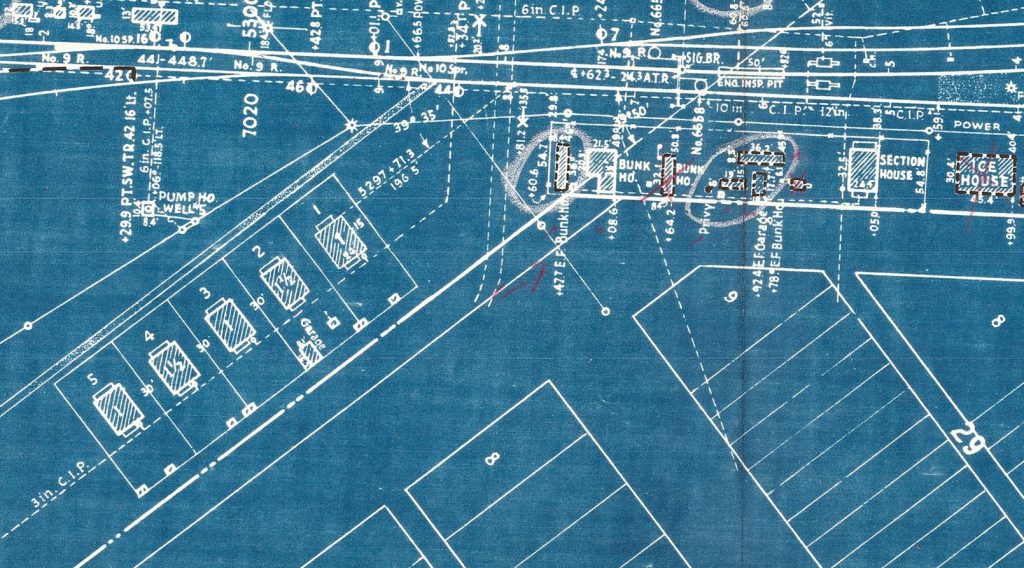
Lynndyl was a railroad town through and through, constructed in 1903 by the Oregon Short Line in its construction of the Leamington Cutoff, a rail line that would become part of the San Pedro, Los Angeles & Salt Lake Railroad soon after completion. Originally called Leamington Hill Station, it was the junction between the Leamington Cutoff and the original Provo Subdivision that was built by the Utah Southern Railroad in 1879. The Oregon Short Line built the Leamington Hill facilities to its standard plans, including a section house and eleven worker houses on “Company Row” facing 100 West. A section house was the home of the section boss and his family, if he had one – the position named because he led a team of track maintainers responsible for a section of the route. The section house and six of the employee homes were built to the single-story section house plan, and the remaining five employee homes were built to a 1-1/2 story design.


The Leamington Cutoff was built as a defensive response to Senator William Andrews Clark’s San Pedro, Los Angeles & Salt Lake Railway, which was building a new route from the San Pedro Harbor to Salt Lake City. The Union Pacific system, which included the Oregon Short Line, was owned by E.H. Harriman; while both railroad companies engaged in a construction and courtroom war to beat the other out of the territory, eventual negotiations led to a compromise where the SPLA&SL would purchase all OSL properties south of Salt Lake City in exchange for Harriman receiving half interest in the California company. Leamington Hill Station was changed to Lynn Junction in June 1903; the Leamington Cutoff was sold to the SPLA&SL the following month in July. In April 1905 the name was again shortened to Lynn, but when a post office was established in May 1907 the railroad town became Lynndyl.
Section crews migrated at the whims of railroad officials and rarely stayed on one section for very long. The 1910 United States Census lists John C. Henderson, a native of Pennsylvania, as the Lynndyl section foreman. His wife Sarah and children Florence and James occupied the section house. In 1920 the section foreman was Inalen Sadaichis, who emigrated with is family from Japan in 1918. Mr. Sadaichis’ section gang at that point consisted six Mexicans and one Irish laborer. By 1930, another Japanese gentleman occupied the position with his family, Mr. San Inara. He, his wife and their seven children all crammed into the two-bedroom section house. The section gang grew to ten people total, one Japanese and nine Mexicans. During the Great Depression the railroad replaced all single immigrant workers with married Millard County natives under John E. Wellington.
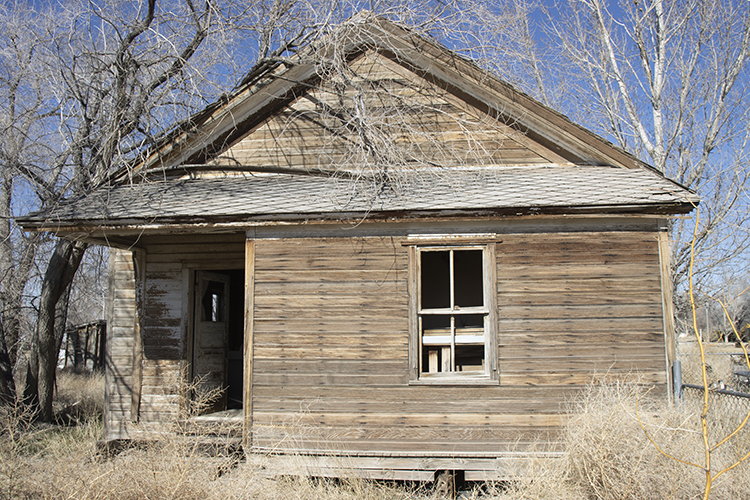
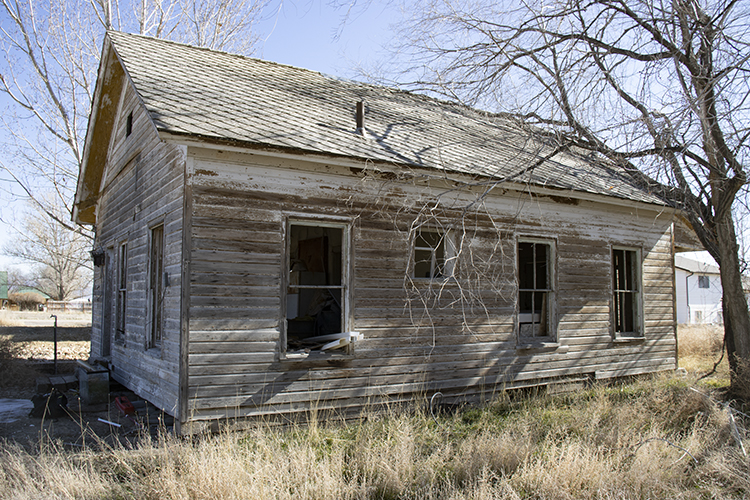
By 1948, railroad property maps indicate that only the section house and three of the single-story employee homes remained, the others being demolished. At some point after 1968, Union Pacific sold off all remaining structures on its property, including the section houses, which were moved to other lots within Lynndyl and surrounding towns. Ed Dutson, one of the section men at the time, bought three of the one-story section houses, moving two to his land across the street from the city park and trading the third to the house mover who transferred them. One was grafted into the back of the primary Dutson residence, and this one became their “back house,” situated behind. It was flipped so that the back door became the front, the back porch was walled in as an extra bedroom, a modern bathroom installed in the former rear bedroom and the wall dividing the kitchen from the rear bedroom was removed. One of the former front windows was cut out as the new back door. Apart from these changes, the structure is remarkably intact in its original design.
Local children lit the front bedroom on fire, and with further degradation due to weather and neglect, in January 2022 the property owner began exploring options to demolish or salvage the section house. One of Ed Dutson’s descendants still lives in the only remaining 1-1/2 story section house on Company Row.
Paint
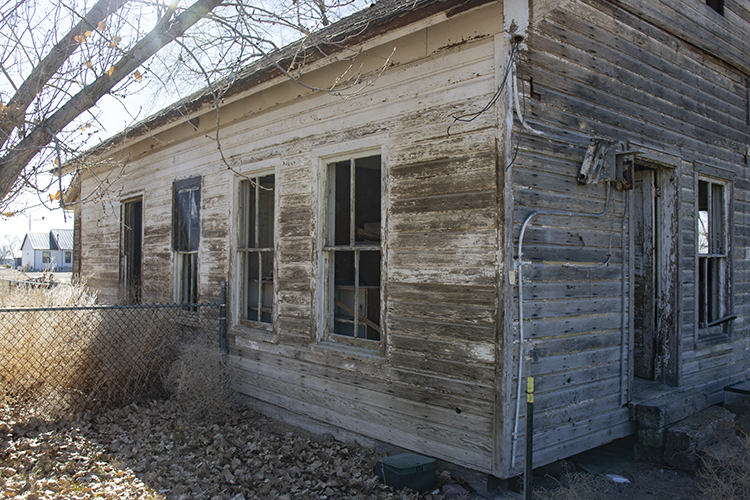
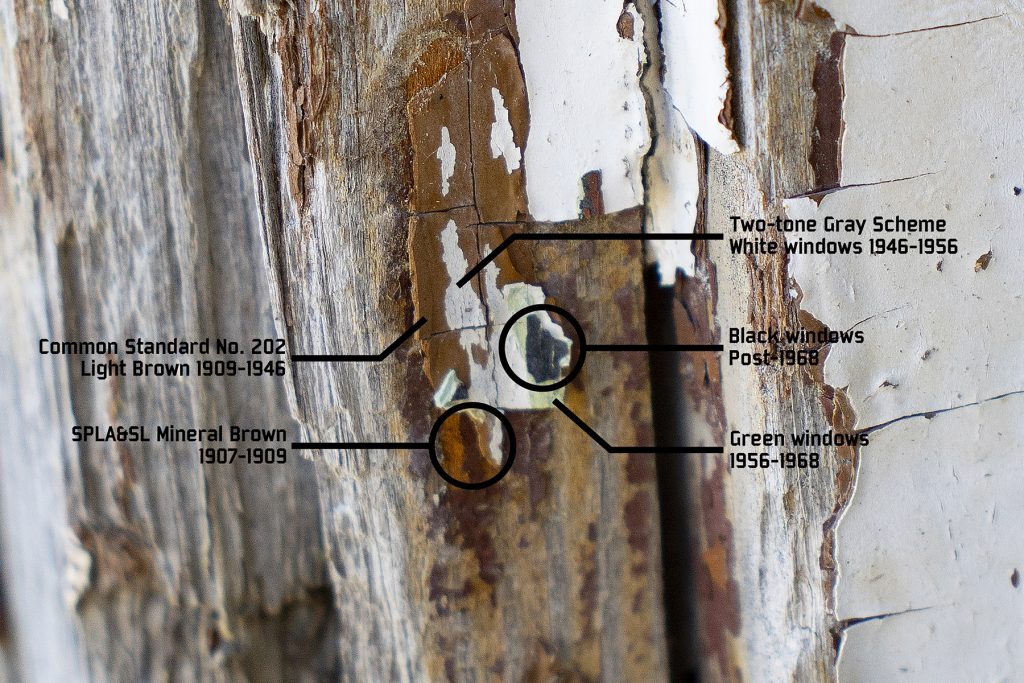
Paint samples were taken from several points in and outside the surviving Lynndyl section house on January 31 2022, which corresponded with paper documentation. Please note that while the colors were digitally sampled from photographs of the paint chips to create the illustrations below, due to variables in the photograph’s exposure and color rendering, plus the settings of your monitor, they may not be accurate representations of the actual colors in direct sunlight.
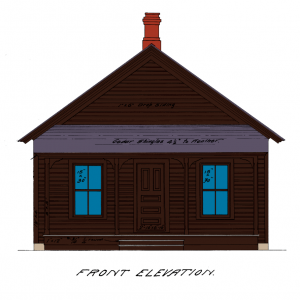
1907: San Pedro, Los Angeles & Salt Lake specified “Mineral Brown” on the entire exterior.
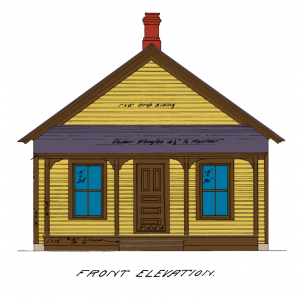
ca. 1910: The Union Pacific System adopted a new structure standard as part of the Common Standard 22 specifications. Since the Union Pacific held half interest in the SPLA&SL, these common standards applied to the Salt Lake Route as well.
–Walls CS-201 ‘Colonial Yellow’
– Trim CS-202 ‘Light Brown’
– Roof CS-211 ‘Slate Color Stain’
– Porch floors CS-213 ‘Gray Floor Paint’
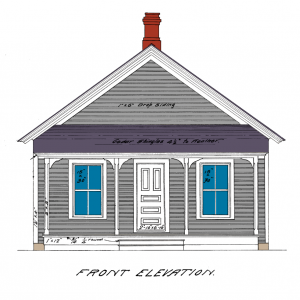
1946: Union Pacific adopted a two-tone gray paint scheme similar to the paint scheme applied to its passenger cars that were not assigned to Streamliner service. While this color scheme calls out two colors of gray on the exterior, a darker gray on the lower half of the wall and a lighter gray on the upper half, analysis of paint on the section house indicates that only the lighter gray was applied on the entire wall. The trim was white.
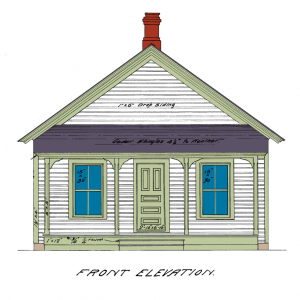
1956: Color standards for structures changed to white walls with light green trim.
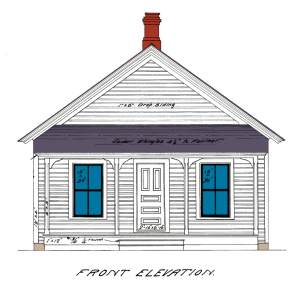
1968: Color standards for remaining wood structures changed to all-white with black window sashes.
Interior
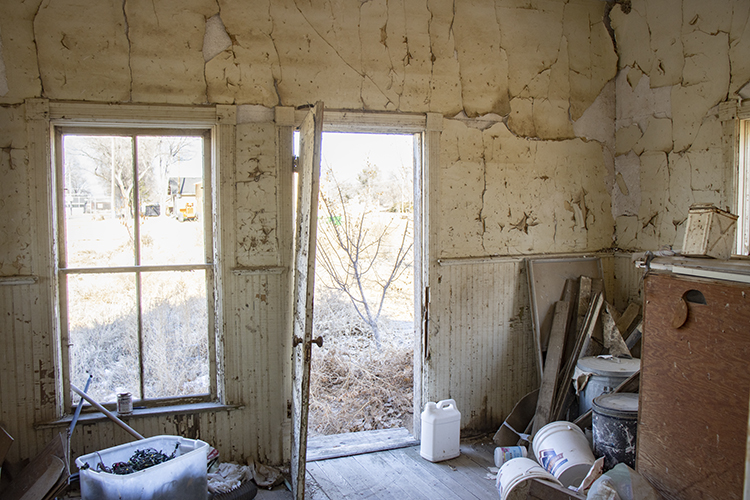
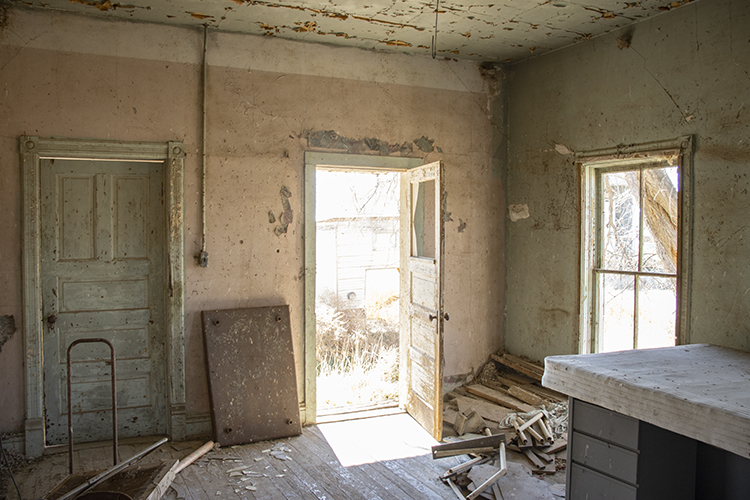
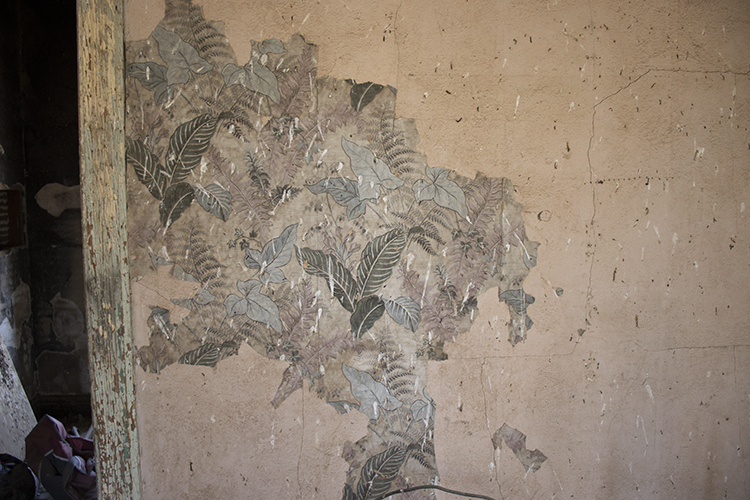
The original building did not account for a bathroom since it was designed and built before interior plumbing was a possibility. The 1907 SPLA&SL blueprints were updated at an unknown date to include a bathroom addition with tub, toilet and sink in a walled-in portion of the back porch accessed through the rear bedroom. This section house, however, was upgraded by walling off half of the rear bedroom to create a bathroom without the need of an addition.
After being sold off to private interests, the front porch, now flipped to be the back, was walled off to add another bedroom, with the front door becoming the new bedroom door and one of the front windows being cut out to form a new door to the outside. The wall dividing the kitchen from the former back bedroom was demolished to create a larger front room.
Sources
Strack, Don. “UP Bridges and Buildings.” https://utahrails.net/up/up-bridges-buildings.php
SPLA&SLRR Salt Lake Division. O.S.L. Standard 24×64 Depot with Living Rooms Drawing 292-K-3. March 14, 1906.
Union Pacific Railroad Painting Guide, 1903-1930 Common Standard No. 22. Omaha: Union Pacific Railroad Historical Society, 1981.
Thirteenth, Fourteenth, Fifteenth, and Sixteenth Censuses of the United States, Washington, D.C.: National Archives and Records Administration, 2012.
Special thanks to Austin Buhler for allowing field research on his property and Derrick Dutson for sharing his family history.
That is my grandparents’ “back house.” The house with the blue siding to the side of it is my grandparents’ house. My grandfather was a section man in Lynndyl and lived with my grandmother in a small house on the property. They had a large family and needed more room for the 8 children (I’m not sure how many they had when they bought the house). From what I was told, my grandfather purchased 3 section houses that were adjacent to the yard, moved two of them to his property (which is where the house is currently located) and gave one of the houses to the person who moved the other two houses as payment. One of the houses was moved next to the house they already owned and was joined onto the house as an addition (which is the house with the blue siding) and the other house is this “back house.” The “back house” had no running water in it. My father tells stories of him and his 3 brothers sleeping in the “back house” while my grandparents and the 4 girls slept in the main house. By the time I came around, my cousins and I would have all kinds of adventures in the “back house” and would get in trouble for climbing up in the attic. My uncle currently lives in another section house near the yard in Lynndyl which is the last house still standing on “company row.”
My father-in-law lived in one of those homes approximately 1935 to 1943 when he moved to Oak City.
My father-in-law lived in one of those homes with his family from about 1935 to 1943